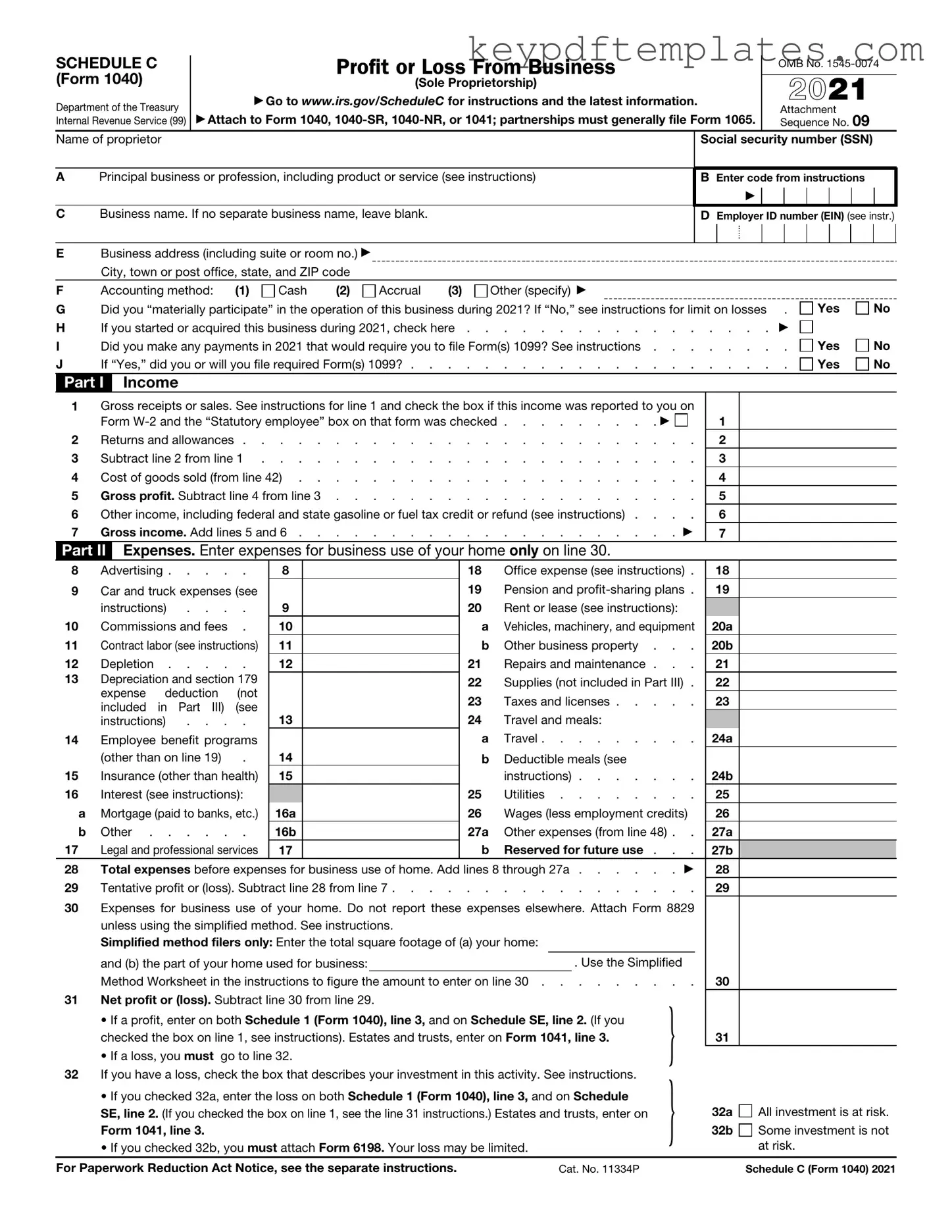
Get IRS Schedule C 1040 Form
Key takeaways
The IRS Schedule C (Form 1040) is essential for individuals who are self-employed or operate a sole proprietorship. Here are key takeaways to keep in mind when filling out and using this form:
- Purpose: Schedule C is used to report income and expenses from a business you operated or a profession you practiced as a sole proprietor.
- Eligibility: You must file Schedule C if you have net earnings of $400 or more from self-employment.
- Record Keeping: Maintain detailed records of all business income and expenses. Accurate documentation is crucial for substantiating claims on your tax return.
- Income Reporting: Report all income received from your business activities. This includes cash, checks, and credit card payments.
- Expense Deductions: You can deduct ordinary and necessary expenses related to your business. Common deductions include supplies, utilities, and business travel.
- Home Office Deduction: If you use part of your home exclusively for business, you may qualify for a home office deduction. This can significantly reduce your taxable income.
- Net Profit or Loss: At the end of the form, you will calculate your net profit or loss, which will be transferred to your Form 1040.
- Self-Employment Tax: Be aware that self-employment income is subject to self-employment tax, which covers Social Security and Medicare taxes.
- Filing Deadline: Schedule C must be submitted by the tax filing deadline, typically April 15, unless an extension is filed.
- Consultation: If you have complex business activities or uncertainties, consider consulting a tax professional for guidance.
Similar forms
The IRS Schedule C (Form 1040) is an important document for self-employed individuals and small business owners. It reports income and expenses related to a business. However, it's not the only form that serves a similar purpose. Here are four other documents that share similarities with Schedule C:
- Form 1065: This form is used by partnerships to report income, deductions, and credits. Like Schedule C, it provides a detailed breakdown of business finances, but it’s designed for multiple owners rather than a single proprietor.
- Form 1120: Corporations use this form to report their income and expenses. Similar to Schedule C, it details the financial activities of a business but applies to C corporations instead of sole proprietorships.
- Form 1120S: This form is for S corporations. It allows businesses to report income and deductions, much like Schedule C, but it’s tailored for corporations that have elected to be taxed under Subchapter S of the Internal Revenue Code.
- Limited Liability Company Agreement: Essential for LLCs to outline key operational details and member roles, providing a framework similar to other tax documents like Schedule C. For more information, refer to the Limited Liability Company Agreement.
- Schedule E: This form is utilized for reporting supplemental income and loss, including rental income. While Schedule C focuses on business income, Schedule E allows individuals to report income from various sources, including partnerships and rental properties.
Each of these forms plays a crucial role in helping the IRS understand different types of business structures and their financial activities. Understanding their similarities can help you navigate your tax obligations more effectively.
Misconceptions
Understanding the IRS Schedule C (Form 1040) can be challenging. Here are ten common misconceptions about this form, along with clarifications to help you navigate it more effectively.
-
Only self-employed individuals need to file Schedule C.
Many believe that only those who are self-employed must use Schedule C. However, anyone with income from a business or a sole proprietorship needs to report that income using this form.
-
All business expenses can be deducted.
Not all expenses qualify as deductions. Only ordinary and necessary expenses directly related to the business can be deducted. Personal expenses do not count.
-
Filing Schedule C guarantees a refund.
Filing Schedule C does not automatically result in a tax refund. The amount of tax owed or refunded depends on total income, deductions, and other factors.
-
Schedule C is only for full-time businesses.
Part-time businesses and side gigs also require the use of Schedule C. Any income generated from a business activity must be reported, regardless of the time commitment.
-
Once filed, Schedule C cannot be amended.
It is possible to amend Schedule C if errors are discovered after filing. Taxpayers can submit a corrected return to address any mistakes.
-
All income must be reported on Schedule C.
While most business income should be reported, some income may not need to be included, such as gifts or inheritances. It's essential to understand what qualifies as business income.
-
Expenses must be paid in cash to be deductible.
Expenses can be deducted even if they were incurred on credit. What matters is that the expense is related to the business and is documented properly.
-
Schedule C can be filed without supporting documents.
While you may not need to submit documents with your return, it is crucial to keep all receipts and records in case of an audit.
-
Only large businesses need to file Schedule C.
Both large and small businesses, including freelancers and independent contractors, must file Schedule C if they earn income from their activities.
-
Filing Schedule C is the same as filing a personal tax return.
While Schedule C is part of the personal tax return (Form 1040), it specifically addresses business income and expenses. It requires additional information not needed for personal income alone.
By understanding these misconceptions, taxpayers can better prepare for filing their taxes and ensure compliance with IRS regulations.
More PDF Templates
Florida Tax Return - The representative can communicate with tax authorities on behalf of the taxpayer.
For those navigating the complexities of rental agreements, it is essential to have clear communication; therefore, landlords should be familiar with the procedure for utilizing the Florida Notice to Quit form, which can be conveniently found on sites like Florida PDF Forms to ensure all legal requirements are met before proceeding with eviction processes.
Printable Job Application Template - Complete this form to apply for open positions within our company.
Daycare Receipt - This document will be essential if any disputes arise regarding childcare services.
Form Specs
| Fact Name | Description |
|---|---|
| Purpose | The IRS Schedule C (Form 1040) is used by sole proprietors to report income or loss from their business activities. |
| Filing Requirement | Individuals must file Schedule C if they earned income from self-employment and their net earnings exceed $400. |
| Deductible Expenses | Business expenses such as supplies, advertising, and vehicle use can be deducted to lower taxable income. |
| Governing Law | Federal tax laws govern the use of Schedule C, specifically under the Internal Revenue Code. |
Documents used along the form
The IRS Schedule C (Form 1040) is essential for self-employed individuals to report income and expenses from their business. However, several other forms and documents often accompany it to provide a complete picture of a taxpayer's financial situation. Below is a list of these important documents.
- Form 1040: This is the standard individual income tax return form used by all taxpayers in the United States. It serves as the primary document for reporting income, deductions, and tax liability.
- Schedule SE: This form calculates self-employment tax for individuals who earn income from self-employment. It helps determine the amount owed for Social Security and Medicare taxes.
- California Vehicle Purchase Agreement Form: Used in California for vehicle sales, this document outlines terms between buyer and seller, including price and warranties. To access this essential form, find the form here.
- Form 4562: Used to claim depreciation and amortization, this form is important for business owners who want to deduct the cost of certain assets over time.
- Form 1099-NEC: This form reports non-employee compensation. If a business pays an independent contractor $600 or more, this form must be issued to the contractor and filed with the IRS.
- Form 8829: This form is used to claim expenses for business use of a home. It helps self-employed individuals deduct a portion of their home expenses related to their business activities.
- Receipts and Invoices: While not formal IRS documents, maintaining receipts and invoices is crucial for substantiating income and expenses reported on Schedule C. They provide necessary proof during audits or reviews.
Collecting and organizing these documents can simplify the tax filing process and ensure compliance with IRS regulations. Each form serves a specific purpose, contributing to a comprehensive understanding of one’s financial obligations and entitlements.